Extensio animi ad magna - Stretching the souls to great things

Sunday, 29 March 2015

Reading First Kings

This book is once again another story of the tragedy of perhaps the most convoluted family in history. The book goes from good to bad over and over again. The cycle is almost enough to make your head spin like a record. One minute the people are loving God, and obeying Him with all of their heart, and the next, they are loving idols, and disobeying God, turning their backs on Him.

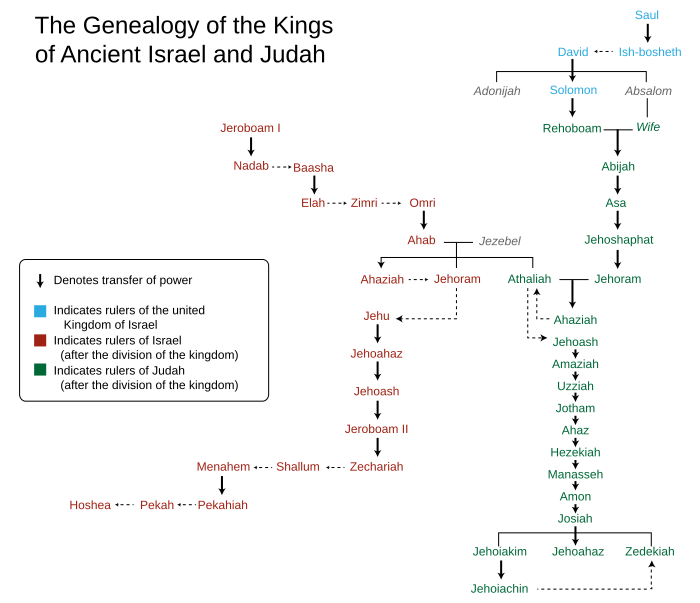
The book's central character is Solomon. His story is hilarious, and yet extremely saddening. It shows that God has a keen sense of ironic humour.

Solomon was David's youngest son, yet once again defying the traditional laws (much like David's anointment as king), Solomon is crowned the next king of Israel. His reign begins on a high note, with God continuing the same relationship that he originally had with David. He grants Solomon one thing, and Solomon being a smart, mature, leadership qualified man, chooses wisdom, in order to help govern his people in the best way possible.

But with all the wisdom in the world, after continually making amazing choices in regards to ruling over his people, Solomon messes up grandly in two ways. First, he gets distracted, and secondly, he falls away from God.

Solomon gets distracted by things of the world. Initially he starts off by committing his wisdom to use for God. He makes decisions that are meant to further God's kingdom, and dedicates himself to building a temple. But soon, Solomon attempts to build himself a kingdom. He starts by accumulating wealth and riches past that which was required for the temple. He also stockpiles women and wives, ending up with 700 wives. All of this distracted him for his real mission, and led him astray.

All of these distractions add up to Solomon falling away from God. In almost a mind-blowing fashion, Solomon loses his commitment to God. While the Bible does not explicitly state that Solomon loses his faith, there are references to his disobedience in later years. The story of Solomon ends rather abruptly turning to his descendants. The Bible does make mention of the fact that Solomon never fully turned away from God, but he also never fully committed himself to God.

This can remind us of the warning in Revelations 3:14-22, regarding being lukewarm. According to this passage, God spits out those who are lukewarm. He wants us to be fully committed, raring to go.

So with all the wisdom anyone could ever imagine, Solomon still made the wrong decision and chose the world over God. His legacy took a major hit because of that. This should serve as a warning sign for us. Rather then seek out wisdom, we should be seeking out God. Many fall under the false impression that wisdom will grant all the answers; only God could ever do that. Even with all the answers in the world, we will still mess up unless we act as servants for God, as partners with Him.
Sunday, 8 March 2015

Reading Second Samuel

Second Samuel is another interesting picture of perhaps the second most heralded character in Israel's history; King David. There are really three contrasting portraits painted of the man throughout the book, and throughout the rest of Deuteronomistic History.

First, David as the young, courageous shepherd. This part of the story painted David in an extremely positive light. He was labelled as the obedient son, doing the dirty work for his father and his brothers multiple times. He was the one left to watch the sheep while his brothers participated in a special meal. He was the one who was left to watch his father (and the sheep again) while his brothers gained respect by fighting in the king's army. Yet, you never read about any complaints from David. In fact, he keeps mainly to himself, supposedly writing psalms after psalms during his time as a shepherd. When he does get a chance to be thrust into the light, he immediately takes it, eager to prove himself, not to his brothers who get mad at him, or even the king who watches him closely, but rather to the one thing that he finds hope in; God.

Even in David's teenage years, he remains quiet, yet extremely confident and courageous. He is thrust under the wings of an extreme insane king, Saul, and his life is threatened multiple times. He doesn't run and hide, but rather chooses to remain, and wait for God's command.

Second, David is the masterful, self-confident strong leader, making himself a famous king never to be forgotten. The people adore him, idolize him, and even worship him. His enemies were continually frightened by him, scared to even think about standing up against him. In a way, David was the greatest human king Israel would ever have. In fact, he can even be considered one of the greatest leaders ever to grace this planet, as a political and military conqueror.

Goodness of God Ministries
Yet, through all of that good, there still remained an evil in David. David was initially very controlled with his war actions. He showed amazing restraint in his campaign in defence from Saul. Yet, at some point, he lost that restraint and turned into a ruthless man, showing no conscience over ordering an innocent man's death. He also lost all morals and consideration for God, and turned to multiple worldly sins to satisfy his own craving for power. He turned to adultery, to worldly fortune, to anything but God. And ultimately, that led to David's downfall.


Monday, 2 March 2015

Rick Warren's A Life of Purpose Review

Rating: 9.2/10
Website: http://rickwarren.org

This is perhaps my favourite sermon. It has impacted my life the most thus far. I'm the person who likes to plan huge lofty goals, and hopes to one day to make it far in multiple industries. This sermon gives me a slight reality check, provides me with hope, and reminds me exactly what my life is all about.

The talk is a Ted Talk labelled as A Life of Purpose. Essentially, Warren is talking about the success of his book, A Purpose Driven Life. Surprisingly, this book, although very Christian in nature, averaged up to a million copies sold each month in 2006. Warren states that he thinks the reason for this is spiritual emptiness. Spiritual emptiness brings a life with no purpose. The issue of no purpose is not a religious problem, but a human problem.

A major part of this speech is Warren's testimony about his trials as a successful author. Warren states that he struggled to find the purpose behind the success of his book. Two things happened as a result of the book to Warren; a huge amount of money flooded into his household, and he garnered international attention. Now according to his worldview, which is what he describes is what he is betting his life on (that Jesus is who He claimed to be), this attention and money had to be put to a certain use.

So Rick Warren made decisions regarding the money, such as not using it for himself, giving it back to the church, and finally setting up charitable organizations. Warren concludes that the testament of a good life is not about feeling good, but rather being good, and doing good things.

Finally, Warren also had to deal with the attention, which he said was even more difficult then dealing with the money. Attention has everything to deal with influence Warren argues. The purpose of that influence is to speak for those who have no influence.

Perhaps the highlight of this speech, is Rick Warren's interpretation of the story of Moses, especially concerning the episode with the burning bush. Through this burning bush, God is talking to Moses. One of the questions God asks is, "What's in your hand?" As Warren explains, this may be the most important question you are ever asked. Moses replies a shepherd staff. God tells him to throw it down, and it turns into a snake. God then commands Moses to pick that snake up, and it returns to its original form as a staff. Key to this story is the shepherd staff in Moses' hand. It represented his identity as a shepherd, it was a symbol of his income, and finally it was a symbol of his influence. God asked him to lay that all down at His feet, and He made it come alive.

So what's in your hand? What has God given you to use? What can you do to make the world a better place? What is your life wired to be like?

Monday, 23 February 2015

Reading First Samuel

Especially in the Old Testament, I love reading about the characters of history. Just like I mentioned in Numbers, it's amazing to think that these events actually happened, and these people actually walked on this planet. I've really been focusing on certain characters from each book, and trying to see if their lessons learned apply to my life.

The character that jumped out at me from First Samuel is Saul. An interesting exercise that I like to participate it when reading historical narratives in the Bible, and focusing on these characters, is to select certain qualities that are similar in myself. I also like to search for qualities that I don't have, but would like to work on.

Saul is an interesting character, and a lot can be highlighted from his very eventful life. I want to highlight two specific things though, one negative and one positive.

Starting with the negative, Saul was very power hungry. I think this was the root of almost all of his problems. He was continually searching for more power, or to maintain his control or grip over the power he already had obtained. Ultimately, this consumed his life, and flooded over into his decisions and actions, which in turn changed Saul's character. He went from a shy, mild mannered man, to a angry, self-conscious, wary, short-fused king. He spent much of his life searching for David, to kill him to maintain his own hold on the throne. He snapped multiple times in the quest of control over the throne, throwing spears at multiple people. He decided to disobey God, just to get the favor of the people to keep his power. He even went ahead and offered sacrifices to God without the priest (Samuel) just to make sure the people didn't leave him. All of Saul's actions were drastic measures to keep the power or gain more.

However, Saul wasn't always this way. Before he was anointed as king, Saul was the obedient, meek son. He jumped at the opportunity to help his father, and was well respected in the community. It was only after he tasted power for the first time that his character changed.

I feel a slight connection with Saul. I have the same issue where power can become an overtaking search in my life. I believe there are many Christians who have the same problem. For some, it is a matter of staying away from those leadership positions that offer power. But we all can't do that, and sometimes it is better to have Christians in those leadership positions.

The best tip that I have found that works, is rather then make that leadership position about you, and your decisions or successes, make it about God. Turn everything back to the Lord. If Saul would have done that as king, he would have been recognized as a success instead of a failure, a madman. Same as every leader in the world!

Friday, 13 February 2015

The Grocery Store Brawl

Check out my first published book! I wrote this short story as a school project in Grade 7, and have been working on the illustrations ever since. This is the first book in my Green Guy series, geared towards young kids.

https://itunes.apple.com/ca/book/the-grocery-store-brawl/id963257195?mt=11


Friday, 6 February 2015

Reading Ruth

Ruth has continually been a book in the Bible that I've struggled to get or understand, surprisingly. I say surprisingly for a few reasons. First, it's such a short book. Second, it is such a commonly heard story. Thirdly, it's exactly that; a historical story.

Whenever I read books from the Bible, I'm always searching for higher meaning, or a greater purpose. Because the Bible is essentially the Word of God, I continually feel that I have to search for the reason why each book is included, each sentence, each word. This can be a good thing, but sometimes it takes away from the overall experience of reading the Bible. A balance has to be found between a search for factual knowledge and enlightenment, and for personal application.

So, when it comes to Ruth, while I continually search for that factual enlightenment, or amazing tidbit of insight, I should also be searching for the personal impact or lessons that can be applied to my life. For some reason, I never consider that God may have included these stories simply for the lessons applied to the present.

Wikimedia
So what personal lessons can be taken from Ruth? Actually, the book is chalk full of them when you read through it with that goal in mind.

First, family is extremely important. Ruth is the person that God is using as the model in the story. Her first defining quality that is revealed is her dedication to her family. While the easiest decision would have been to stay in her home country and get re-married, she was so dedicated to her family, and her mother-in-law that she uprooted her whole future, just to be with Naomi, and to support her.

Second, she was extremely obedient. Whenever anyone asked something of her, or ordered her to do something, she did it wholeheartedly, without ever complaining or asking any questions.

Thirdly, Ruth is an example of how to live through pain and come out of trials in the end. Ruth must have been extremely distraught with the death of her husband, and most of her family. Yet, she struggled through it, and ultimately came out on top, with a new husband, who was extremely respected, and wealthy. She herself was also respected in a small community she could call family, and she bore sons who would grow to become great men historically.

Commonly Ruth is used as an example of a Gentile being accepted into God's family from the Old Testament as a lesson. I chose not to include this, because there is no proof that Ruth actually accepted God into her heart. The most likely conclusion is that she did, based upon her statement that she wanted Naomi's God to be her God, yet there is no evidence past this. As a local pastor once said, "assumption is the lowest form of knowledge." While it does make for a great story, I would choose to draw other, stronger conclusions from the book, rather then just possibilities.


Thursday, 5 February 2015

Reading Judges

Recall the discussion of the two-fold promise of God in Deuteronomy? The one where He promised amazing things if the Israelites obeyed Him, and extreme punishment if they disobeyed Him? The book of Judges provides a crystal clear historical example of the results of that promise.

The cycle in Judges is stupendous. You'd think that the Israelites would have learned from their mistakes after a few times of doing the same things over and over again, and having the same results every time. However, they didn't, and the cycle continued on and on.

Here's what happened in that cycle. It all started with the Israelites choosing, much like Adam and Eve in the Garden of Eden, to disobey God. They chose to attempt to follow false gods, or idols, or things of the world. By doing so, they basically turned their backs on God, and decided to place themselves before His will. This sparked God's punishment, which was essentially returning the favour, and turning His back on them. Much of the punishment came in the form of foreigners attacking, terrorizing, and ruling over the Israelites for many years.

Here's the difference between man and God though. While we may turn our backs on God, and God turns His back on us, He is extremely willing to turn right back and around and reconnect in that relationship. In fact, He continually looks over His shoulder while we continue our disobedience, hoping we will see our foolishness, and putting people and situations in place to shake us awake.

Thus begins the next step in the cycle. God hand picks certain people to lead the Israelites back to Him. Most times this happens through a certain warrior who conquers the terrorists of that time period. By freeing the people of that outside influence, this warrior or judge leads the Israelites back to worship of God. When this happens, the people experience a time of safety and fruitfulness.

However, for some unstated reason, the Israelites would always abandon that safety, and would choose to turn away from God. Thus the cycle starts all over, back to the time of choosing false Gods, and being punished. Now we can speculate that the reason for disobedience might be dissatisfaction, longing for more, sinful nature, outside influence, and on and on.

Even though we may state that this should have been the easiest decision in anyone's life, and that the Israelites must have been blind not to see the cycle in front of them, we do the same thing as the Israelites and constantly disobey God. And we have more then the Israelites did in that time, in the form of history from the Bible. Yet for some reason, we continue to disobey God.

Now, there has been an argument made regarding if obeying God actually produces times of perfect happiness and such. Ultimately, my opinion on the subject is that trivial things that used to bother you won't anymore, and that when bad things do happen, you are able to go through those situations with a better frame of mind, or perspective, and therefore with a better attitude.

Ultimately, the book of Judges should provide a lesson for us, one that may be difficult to apply, but is extremely important to at least attempt to take to heart.